

The wolf
Canis lupus
The wolf is one of the most adaptable animals in the world, and perhaps that is why they have become one of man’s most allied domestic animals. What distinguishes the wolf from the other large predators is their flock life and their howling. Here in Sweden, the wolf raises a lot of emotions – both positive and negative – and a hundred years ago it was extinct from our country. Now it’s back.
About
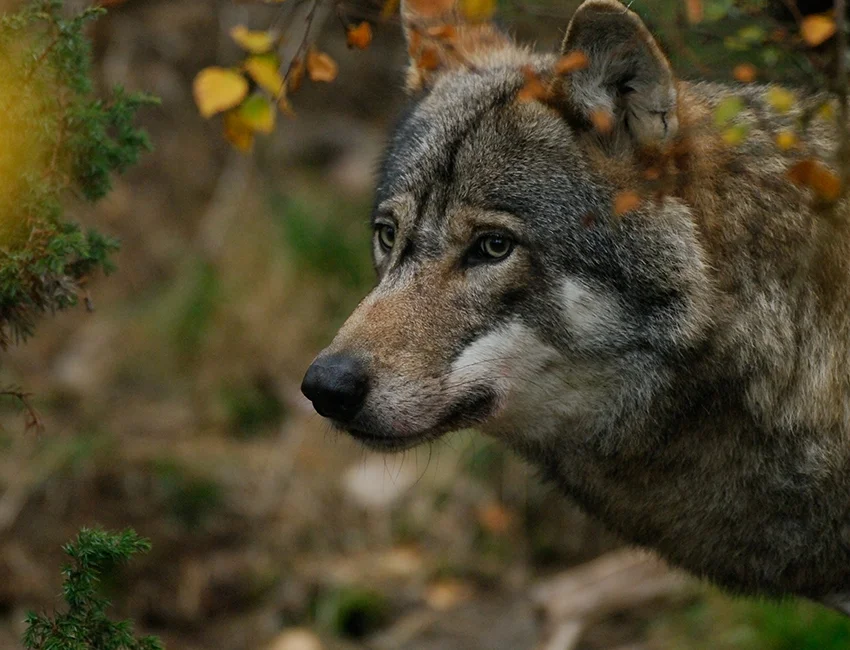
In other parts of the world, the color of wolves varies greatly depending on the environment they live in. There are wolves ranging from white to black. In Sweden, all wolves have roughly the same color. They have gray sides with light beige legs and black patches on the face, back, and tail.
The wolf is a large canine weighing between 30-55 kg. The wolf’s paws are larger than most dogs’, although the very largest dog breeds might have bigger paws than a wolf.
The tail is almost always carried downwards when moving.

Did you know that:
The wolf is the world’s largest wild dog.
The wolf is the progenitor of all domestic dogs.
The wolf’s howling can be heard up to 1 mile under good conditions.
Wolves and dogs can be crossed and produce a completely fertile offspring.
The wolf trots at a speed of about 8 km / h – the top speed (when hunting) is 60-70 km / h (which they can keep a short distance); and they can keep a speed of 40-45 km/h for several kilometers before they get tired.
Fact
Class: Hunddjur (Canidae)
Scientific name: Canids (Canidae)
Conservations status: EN
Size: The shoulder height is 60-80 cm and the length is 80-90 cm.
Weight: 22-55 kilo
Number of youngs: 2-8 puppies are born in May-June. At 5 weeks of age, they start eating meat, and by 10-11 weeks they have stopped nursing. The puppies reach sexual maturity at around 20 months of age.
Conservation status